Redrawing a microchannel every time you change its shape? Making microfluidic prototyping faster with generative AI
Microfluidic devices guide tiny amounts of liquid through narrow channels to mix, split, or direct a flow. Developing a new device means adjusting channel widths and shapes, then making and testing many prototypes. Each change can lead to another round of CAD drafting, 3D printing, and dimensional measurement.
Our idea: generate design files quickly, then use measurements of the physical device to improve the next design.
01 What makes prototyping difficult? — A CAD drawing and a printed device do not always match
Imagine changing the width of a Y-shaped channel. You revise the CAD model, print a new device, and inspect its dimensions under a microscope. When the result differs from the target, you repeat the cycle.
CHALLENGE 1 / DRAFTING
Even one geometry takes time to draw
606–799s
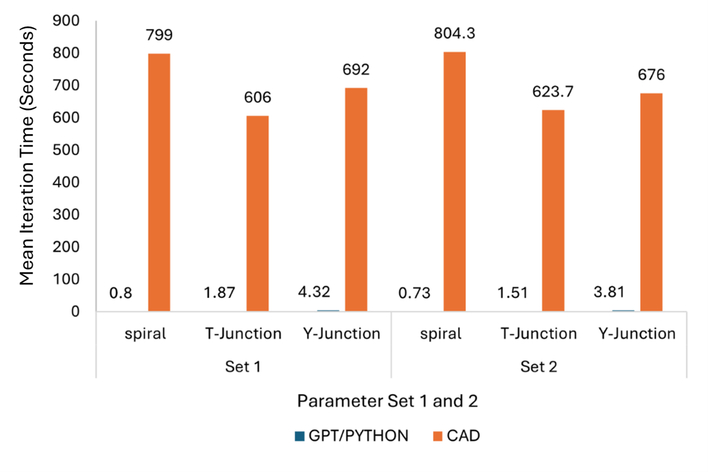
Mean manual AutoCAD drafting time for the three geometries tested in this study.
CHALLENGE 2 / AI
Initial AI-generated geometry can contain errors
Solid channels & misalignment
Early scripts produced solid interiors instead of hollow channels, or misaligned junctions.
CHALLENGE 3 / PRINTING
Correct CAD dimensions can still change during printing
Up to 12.6%
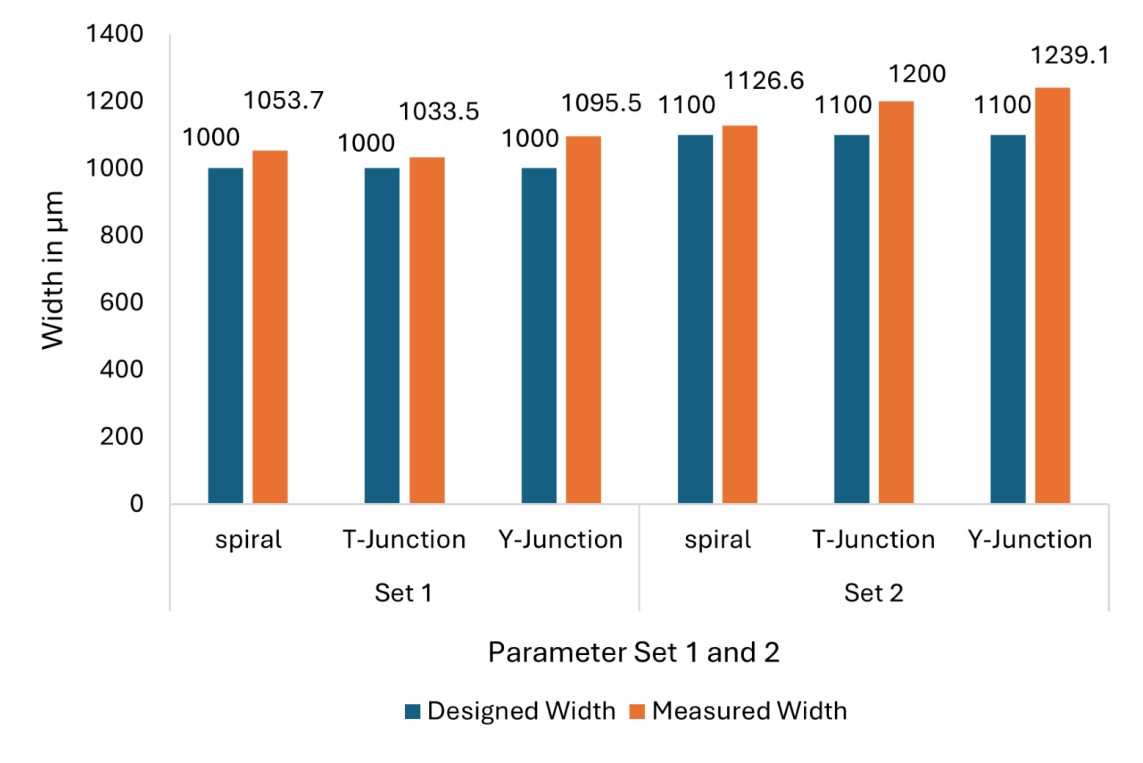
Maximum deviation in overall channel-track width across three geometries and two parameter sets.
Designed width: 1,000 µm. Measured after printing: 1,095.5 µm.
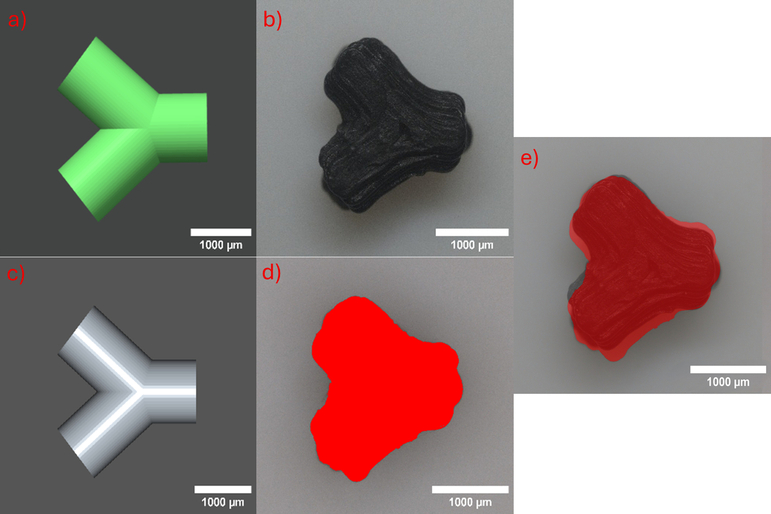
The figure on the right compares CAD models with fabricated Y-junction devices. The target overall channel-track width was 1,000 µm (1 mm). The mean printed width was 1,095.5 µm — approximately 9.6% wider.
Overall Y-junction track width, before correction
1,000 µmdesign →1,095.5 µmmeasured
Paper Table II. These values refer to the external channel-track width, not the internal flow-channel width.
Can we identify where the deviation occurs and use that information to improve the next prototype?
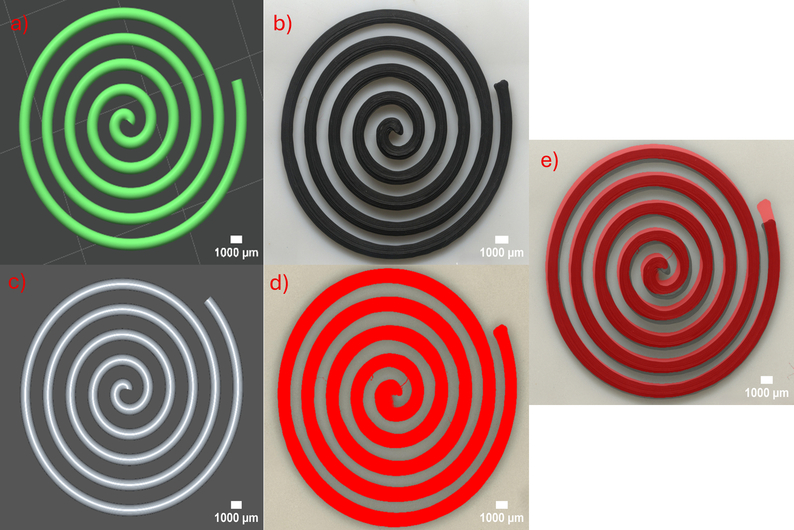
Paper Fig. 6 — Fig. 6 of the paper. CAD designs and FDM-printed Y-junction devices, including comparison with manual CAD.
We give the language model the channel type and target dimensions, then use it to develop Python code. After checking and refining the code, we keep the finalized script and adjust numerical parameters such as width and angle to regenerate the design.
DESIGN → FABRICATE → MEASURE → IMPROVE
① ChatGPTDevelop and refine Python code for the channel geometry
→
② PythonExport SVG/DXF drawings and STL files for 3D printing
→
③ Print & measureFabricate the channel and measure it with a microscope
↶ Feed measured dimensional errors back into the Python parameters and make the next device
Why save and reuse the finalized Python script?
Identical prompts to ChatGPT can generate different code. A checked and finalized Python script, executed under the same conditions, generates the same design files. The LLM helps write the program; the fixed program reproduces the CAD geometry.
A hash is a file’s digital fingerprint. For each geometry, three executions of the finalized script yielded STL files with matching MD5 hashes. This confirmed that the design files were identical across repeated runs.
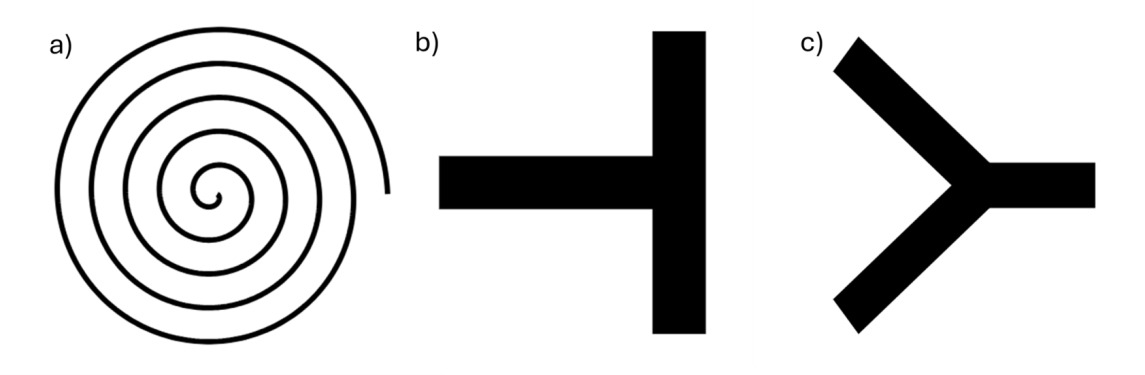
Paper Fig. 3 — Fig. 3. Three channel geometries generated by Python: spiral mixer, T-junction, and Y-junction.Paper Fig. 4 — Fig. 4. CAD geometry and FDM-printed spiral mixer.
03 How much faster? — Regenerate a design in seconds
Once the script is ready, changes to channel width, curvature, junction angle, or spiral loop count can be entered as parameters. The updated CAD files are exported within seconds.
Channel geometry
Finalized Python script
Manual AutoCAD drafting
Spiral mixer
0.80 s
799 s
T-junction
1.87 s
606 s
Y-junction
4.32 s
692 s
Paper Table I; mean of three runs per geometry. Python times cover execution of the finalized script through file export. Manual CAD times cover drafting through STL export.
Paper Fig. 7 — Fig. 7. CAD export time using the finalized Python script versus manual AutoCAD drafting time.
Developing the initial script took approximately 45–60 minutes of interactive work with ChatGPT. Once created, that script eliminates the need to redraw every variation from scratch, making it especially useful when comparing many design conditions or repeating fabrication cycles.
04 Did the printed channels meet the target dimensions? — Measure, then correct
A fast CAD model is useful only when the manufactured device can be evaluated against its target. We verified the digital geometry, fabricated channels by fused deposition modelling (FDM), and measured the printed devices using digital microscopy.
12.6%Maximum deviation in overall channel-track width
3 × 2Three geometries and two parameter sets
10 µL/minNo visible leakage at or below this flow rate in the tested devices
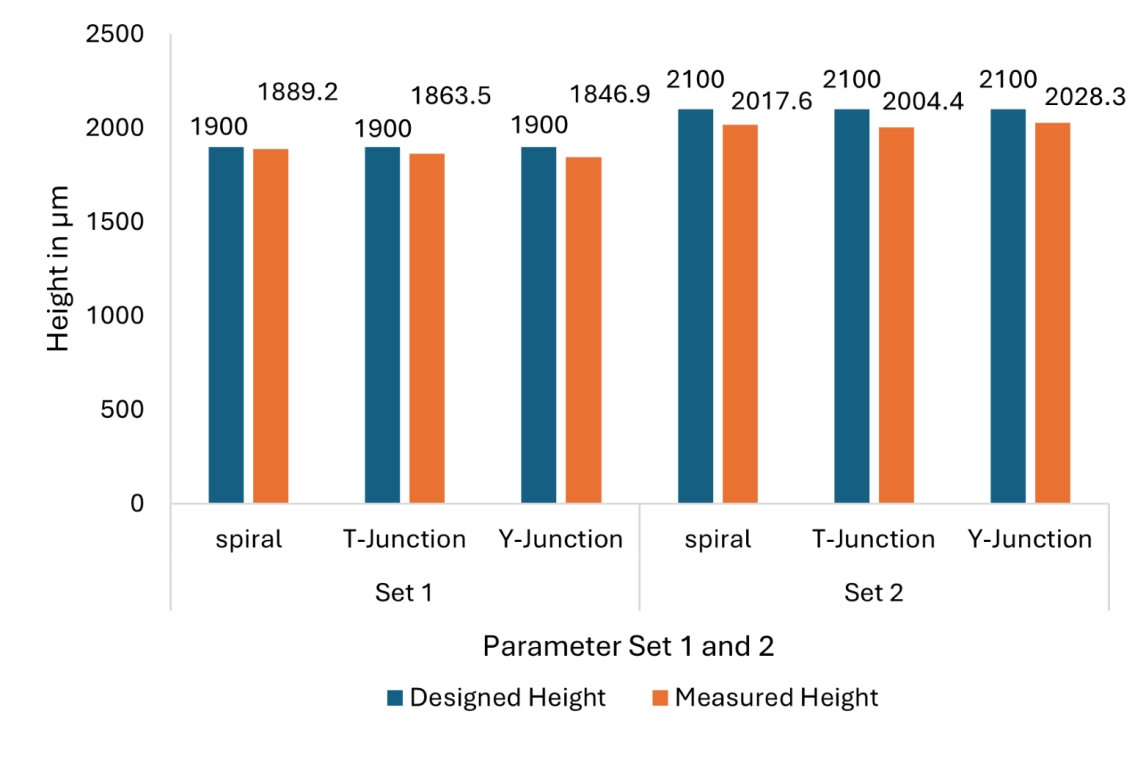
Paper Fig. 8 — Fig. 8. Designed versus measured overall channel-track widths after fabrication.Paper Fig. 9 — Fig. 9. Designed versus measured channel-track heights after fabrication.
Measurements separate geometry generation from printing errors
We first checked the STL dimensions in MeshLab, then measured the fabricated channel-track dimensions under a digital microscope. This comparison showed that the dimensional deviations arose primarily during FDM fabrication.
Using measurements to update the next CAD design reduced width deviations
Channel geometry
1st compensated iteration
2nd compensated iteration
T-junction
+7.60%
+5.6%
Y-junction
+8.57%
+4.8%
Paper Table IV. These values compare the first and second compensated iterations. Devices were fabricated using PLA on a Bambu Lab A1 printer.
Flow testing showed no visible leakage up to 10 µL/min. Leakage began at 15 µL/min for the spiral mixer, 30 µL/min for the Y-junction, and 35 µL/min for the T-junction. The study tested not only whether the geometry could be generated, but also whether the printed channels carried fluid.
The outcome is a repeatable prototyping workflow: generate CAD, fabricate a device, measure the result, and use that measurement to improve the next design.
In fiscal year 2024, as the editor-in-chief of an academic journal, I managed just under 100 papers 📚. All editors and reviewers worked without compensation, and I’m grateful to everyone who cooperated 🙏. I was also unpaid.
To use an analogy, it’s like being a club captain. Of course, this kind of job probably comes to you because you enjoy it 😅.
There are some points for reflection regarding securing enough papers and time management. Nevertheless, I safely completed my term and refreshed myself with MIKAN (mandarin orange) juice from Ehime’s famous orange juice taps 🚰🍊🥤, feeling relieved 🥳.
I was really into Dragon Quest and RPGs as a child. During my trip to Shikoku, I also visited Sumoto City in Hyogo Prefecture, the hometown of game designer Yuji Horii🤩 By car, I could easily get to Awaji Island too🚗
I became a hero with Loto’s sword and shield, the Slime monument, and the stone monument inscribed with “And into legend…”. There weren’t many tourists in Sumoto, so I could enjoy a quiet pilgrimage to this sacred site😎 This town could promote itself more through Dragon Quest, don’t you think?
I visited various castles around Shikoku, but Dragon Quest feels more familiar to me than historical figures. I learned that Yuji Horii graduated from Waseda University’s literature department. People who can create stories have great power, and I believe literature has practical value (though law and economics are considered more practical)✍️. The power of literature may not be visible, but it clearly drew me here myself😊
I visited Sakamoto Ryoma’s memorial in Kochi (Tosa) ⚔️ Why does he remain famous in history?
Perhaps because he was ahead of his time while also rolling good dice with his timing 🎲 I discovered that he was patient and watched for the right moment to act 👀 A trait I also saw in Tokugawa Ieyasu.
Even historical figures share principles with research. Both worlds connect 😉
I took 5 days off and traveled around all 4 prefectures of Shikoku 🚗. Since I was driving a rental car between cities, I didn’t have time to post updates as the driver.
The most notable spot was Dogo Onsen in Matsuyama City, Ehime Prefecture, which had a wonderful atmosphere ♨️. It’s great to visit places during your time off that you don’t typically go to for business 😌
Sunday lunchtime 🍴 As an engineering researcher who pursues originality during the week, I also enjoy exploring new places with my son on weekends. We visited a restaurant we’ve never been to before.
Wow, it’s so cheap 😮 It’s like time has stopped here, as if they’ve made a mistake with their pricing 💰 I ordered chashu ramen and stir-fried vegetables. This place should be preserved as a Showa-era movie set 🪑🥹
Why doesn’t running every day get boring? Running at a slow pace allows you to fully enjoy the seasonal scenery and observe the changes in people 🌞.
When Yoshida Castle and the Yanagi River are surrounded by cherry blossoms, they feel more vibrant and special 🌸🏯. I love watching people enjoying their strolls in the spring sunshine 🥰. Combining outdoor running with sightseeing makes it easier to keep going 💮.